Three Sisters
Heart of the HunterThree Sisters is a strategic fork in the road on the N1, and the point where the pursuit of Thobela Mpayipheli turns on competing calculations of his next move. For Janina Mentz, it is a place to concentrate the manhunt; for Mpayipheli, the choice it offers is a way to become unpredictable. The junction’s importance lies less in its description than in what converges there: a planned roadblock, a fugitive approaching from Beaufort West, and two helicopters sent to intercept him.
The fork in the pursuit
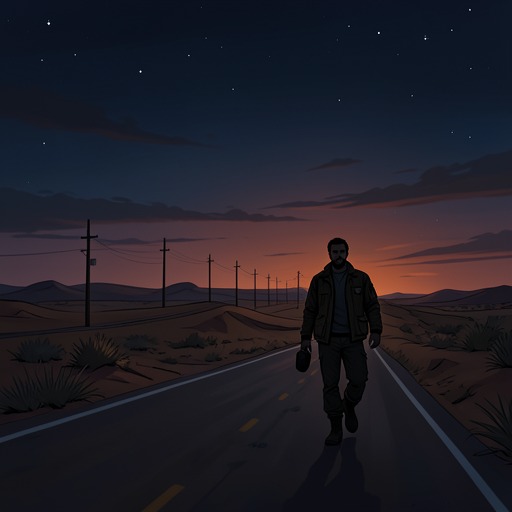
The route to Three Sisters runs through a demanding stretch of the Great Karoo. After Touws River, Mpayipheli considers the distance ahead and the fuel left in his BMW R 1150 GS. He calculates that he must refuel at Laingsburg, then face roughly 200 kilometres to Beaufort West across a highway that is wide and straight. Beaufort West is not the end of the journey: Bloemfontein lies another 500 or 550 kilometres beyond it, a distance he wonders whether he can cover before sunrise. The landscape and the mileage make each decision about speed, fuel, and direction consequential.
Mentz reads the N1 as the likely line of flight. On a large map, she marks a point 77 kilometres north of Beaufort West as the place where the route forks and the possibilities multiply: one branch leads toward Kimberley and Johannesburg, the other toward Bloemfontein and Johannesburg. She assigns the Reaction Unit to form a net at that point. Police stations and traffic authorities along the route are told to gather intelligence, not to act, because the authorities still do not know enough about the armed fugitive to treat every sighting as a safe opportunity for intervention.
The roadblock and the waiting force
As Mpayipheli approaches, Mentz checks whether the roadblock at Three Sisters is ready. Police and traffic personnel are already there, though they complain about the rain in the Karoo. She confirms that they know to check all vehicles, while also asking how soon Captain Tiger Mazibuko will arrive. He is expected within minutes. The scene makes the junction more than a mark on the map: it is a staffed interception point, with the weather already complicating the deployment.
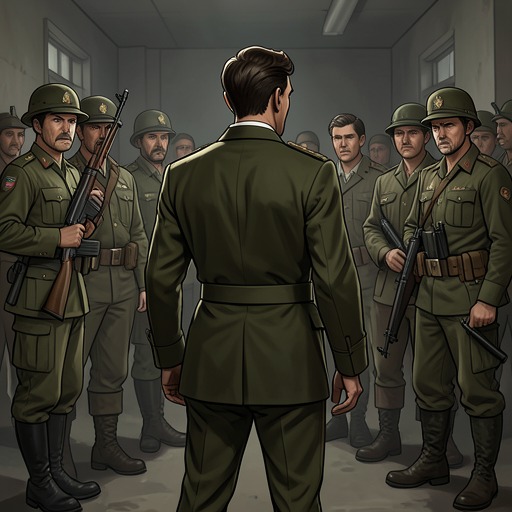
Mazibuko waits inside the vibrating, yellow-lit Oryx, awake while his teammates sleep. He is troubled by what the assignment says about the Reaction Unit. Though conceived as a counter-terrorist and hostage-rescue force, the unit has spent its first thirteen months on simulations and training; its recent operations have included a raid on a drugs den, and now it is to wait at a desert roadblock for a fugitive who may once have been an MK soldier. Three Sisters therefore also registers as a test of the unit’s purpose and of the role it has actually been given.
Mpayipheli changes the pattern
The authorities’ expectation that Mpayipheli will continue along the N1 gives him a pattern to exploit. Studying a road map, he finds the fork at Three Sisters and traces the branch toward Kimberley. It appears to offer more choices. He frames the decision through the logic of a chess game: an opponent searches for patterns, so a predictable course can be offered and then changed. He decides to change direction at Three Sisters, refuel at Beaufort West, and ask about the route to Bloemfontein, hoping that the information will reach the pursuers. The intended misdirection is part of his escape plan, not a spontaneous turn at the junction.
The operational picture briefly seems to confirm Mentz’s reading. Ops Control reports Mpayipheli four minutes out of Beaufort West on the N1, heading toward Three Sisters, and calls Rooivalk One into the air; Rooivalk One and Two are reported operational. Mentz’s prediction is largely right: when she later checks the map, she sees that Mpayipheli did take the N1 and reached the area, though about an hour later than she had predicted. The gap between correctly anticipating his approach and actually stopping him becomes the pursuit’s decisive failure.
Rain and the escape
The helicopters catch up with Mpayipheli near the road, flying low behind him. He sees two of them, their dark bodies and engines close enough to make the pursuit feel inescapable. His speed is just over 200 kilometres per hour, but the weather ahead offers a chance the aircraft may not follow. Rain thickens into a dense curtain; spray and poor visibility force him to slow behind a truck and make the road hazardous. Once the lorry moves aside, he shifts down and passes it cautiously. The helicopter noise fades, and the aircraft are no longer with him.
Afterward, Mentz recognizes how close the interception came. On the map, she checks the distance between the turn-off and the roadblock: it is very near. Mpayipheli had taken the expected highway, and the delay in his arrival had not invalidated her forecast. But the rain had altered what the pursuit could accomplish. As she looks across the North-West Province, the thin red lines of roads make the next problem plain: with too many crossroads, junctions, and turn-offs to cover, even Team Bravo cannot seal every option. Three Sisters thus marks both the moment when the manhunt nearly closes around Mpayipheli and the point after which the road network opens back up against the authorities.